
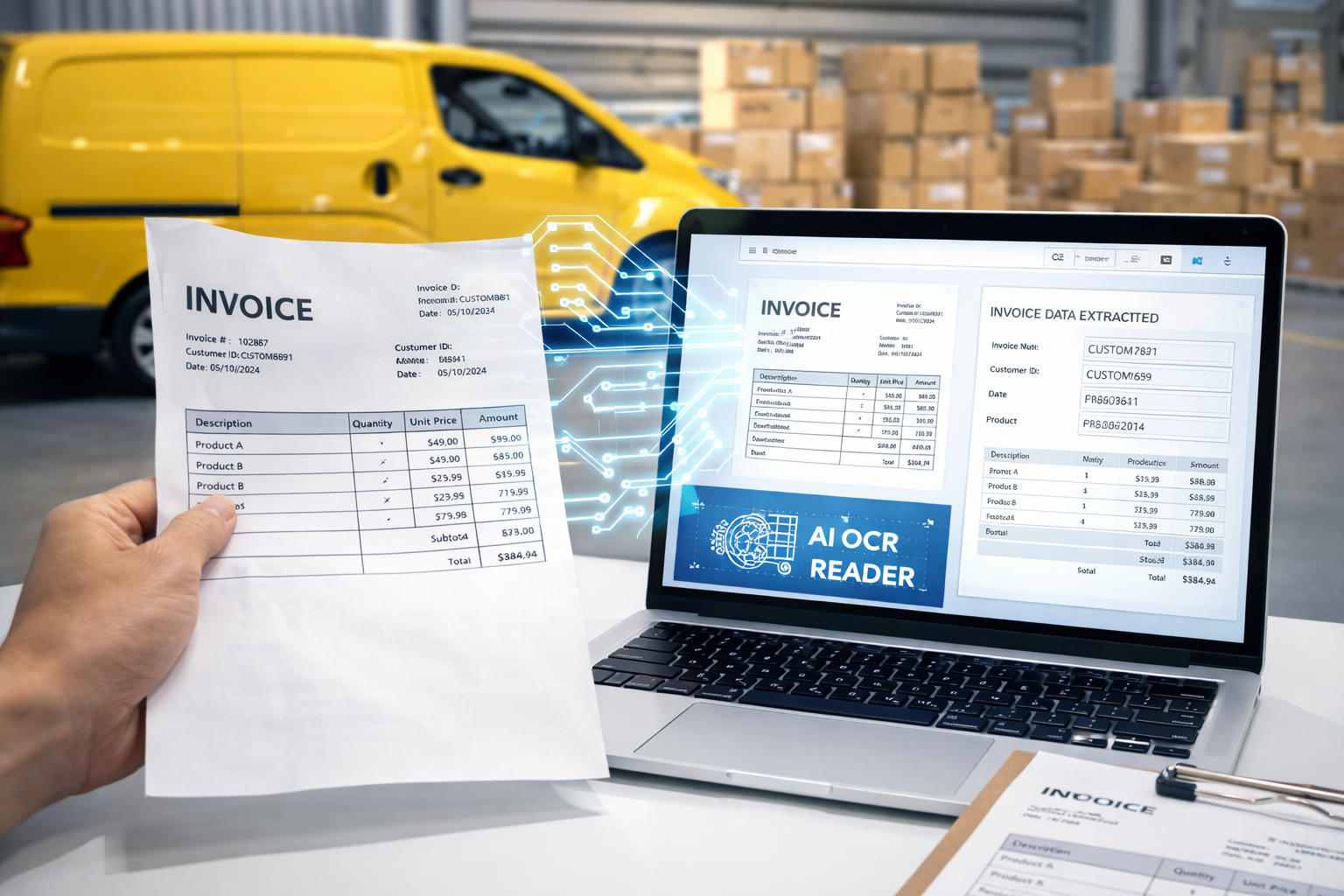
Our enterprise automation solutions are designed to eliminate the hidden operational drag caused by manual document handling. By combining computer vision, natural language processing, and contextual validation logic, Xerovi transforms unstructured data into structured, audit-ready intelligence in real time.
For this project, we partnered with a global logistics and supply chain provider processing over 50,000 mixed-format documents per month. The objective was clear: eliminate the manual bottleneck between incoming documents and ERP systems while drastically reducing cost and error rates.
The result was a context-aware Intelligent Document Processing (IDP) engine capable of classifying, extracting, validating, and integrating complex unstructured documents automatically — achieving 79% cost reduction and 90% faster processing cycles.
This was not just OCR — it was operational transformation.
How a leading enterprise automated report generation and data entry for 50,000+ monthly documents, reducing processing costs by 79% and slashing an 8% manual error rate.
Efficiency Gain
+450%
Processing speed improvement vs. manual
A snapshot of the transformation from manual data entry to automated report generation.
Cost Per Document
Reduced from $5.20 to $1.10
Report Gen Time
8 min → 45 sec avg.
Error Rate
Down from 8% manual errors
Reallocated
Shifted to higher-value tasks
"Our team was buried in spreadsheets and manual report generation. The error rate was climbing, and we were losing days just fixing typos."
— Director of Operations
For document-intensive businesses, relying on manual data entry and report generation creates a bottleneck. Scaling operations shouldn't mean scaling headcount linearly.
Processing 50,000+ mixed documents (forms, reports, invoices) monthly meant a constant backlog. Manual entry averaged 8 minutes per file.
An 8% manual error rate in data extraction resulted in incorrect reporting, compliance risks, and costly rework cycles.
20 full-time employees were tied up in manual transcription and report formatting instead of strategic analysis.
We tried simple template scrapers first. They couldn't handle the complexity.
From document ingestion to actionable intelligence: A human-in-the-loop workflow.
Upload Reports, Forms, Scans, Emails, or API feed.
AI sorts documents by type (Invoice vs Report vs App).
Intelligent data scraping, table parsing, & structuring.
Confidence scoring. High confidence auto-approves.
Data pushed to DB, Analytics Dashboards, or ERP.
Metric: Straight-Through Processing (STP)
Adjust the sliders based on your current document volume.
Annual Manual Cost
$3,000,000
Projected AI Cost ($1.10/doc)
$660,000
Annual Savings
$2,340,000
Automation isn't about replacing people; it's about elevating them. Our strategy focused on:
Staff previously stuck in data entry were retrained as "Exception Analysts" and "Data Strategists".
We ran parallel systems for 4 weeks to build user trust in the AI confidence scores.
| Risk Area | Mitigation |
|---|---|
| Data Privacy | PII Redaction before cloud processing + On-prem hybrid options. |
| Format Variations | Quarterly re-training on new document layouts. |
| False Positives | High confidence thresholds (98%) set for auto-approval. |
The client required a scalable document ingestion system capable of processing over 50,000 monthly documents across invoices, bills of lading, shipping manifests, and customs declarations — all while maintaining strict ERP accuracy. Despite operating a robust SAP/Oracle ERP environment, the ingestion layer remained manual. Skilled logistics coordinators were spending hours daily transcribing, validating, and reconciling data from inconsistent vendor formats. The solution needed to automatically classify documents, extract structured data without rigid templates, validate calculations, perform ERP cross-checks, and push clean data directly into the system — all while maintaining audit traceability and regulatory compliance.
The Intelligent Document Processing platform was deployed as a five-layer automation framework designed for accuracy, scalability, and resilience.
The Ingestion Layer unifies intake through API uploads, email parsing, FTP monitoring, and batch scanning. Image pre-processing corrects skew, enhances contrast, and optimizes readability before analysis.
The Classification Layer uses AI-driven content detection to identify document type automatically, distinguishing invoices from packing lists or customs forms without manual input.
The Extraction Layer operates without fixed templates. Using layout-agnostic computer vision and NLP, it extracts key-value pairs and complex multi-page tables regardless of formatting differences.
The Validation Layer performs automatic mathematical verification, confirming totals, line-item calculations, and tax consistency. It also executes three-way matching against ERP purchase orders and vendor records.
The Integration Layer outputs structured JSON/XML directly into the client’s ERP system via secure API, while maintaining a complete digital audit trail linking each processed entry to its original document.
The system automatically processes high-volume mixed-format documents without template configuration. It extracts structured financial and logistics data, validates numerical consistency, and cross-references ERP records in real time.
It supports advanced table parsing across multi-page documents, flags low-confidence fields for review, and enables human-in-the-loop exception handling for complex cases.
Internally, it shifts operational focus from data entry to analytical oversight, providing real-time dashboards for processing volumes, vendor trends, and bottleneck detection.
Within the first quarter of deployment, measurable improvements were recorded:
Processing Time: Reduced from 8 minutes per document to 45 seconds — a 90% acceleration.
Cost Efficiency: Cost per document decreased from $5.20 to $1.10 — a 79% reduction.
Accuracy: Manual error rate dropped from 8% to 0.4% — a 95% improvement.
Touchless Processing: 86% of documents processed without human intervention.
Annual Savings: $2.46 million in operational cost reduction.
ROI: Achieved within 4 months of deployment.
The system now processes in one hour what previously required two full operational days.
The platform was engineered for audit readiness and regulatory compliance.
All processed documents retain a digital link to their original source file, ensuring complete traceability.
Source files remain read-only, preserving evidentiary integrity.
PII redaction protocols were implemented prior to cloud processing to meet GDPR and CCPA standards.
A quarterly model retraining cycle ensures long-term accuracy as vendor layouts evolve.
Rather than eliminating roles, the deployment elevated workforce capability.
Five FTEs transitioned into Exception Analysts, managing edge cases flagged by the AI. The remaining team members were reassigned to vendor negotiation, analytics, and supply chain optimization roles.
The architecture is modular and designed for horizontal scaling — capable of handling unlimited document volume without proportional increases in staffing.
Future roadmap capabilities include predictive vendor risk analysis, automated compliance flagging, and real-time financial visibility dashboards.
Xerovi Intelligent Document Processing is not a template-based OCR tool.
It is a context-aware automation layer that removes the operational friction between unstructured data and structured systems — delivering speed, accuracy, and financial clarity at scale while empowering human teams to focus on strategic decision-making rather than repetitive data entry.